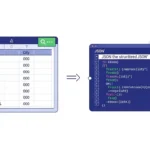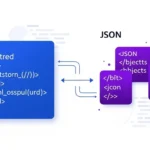
JSON converts to XML conversion is an essential necessity in the modern world of Web development, integration of data as well as system interoperability. Analysts, developers and systems for software often use multiple formats for data which is why the conversion of JSON data to XML is required in the case of working with older systems APIs, configuration files and enterprise software that depend heavily on XML structure.
JSON is light in weight and widely utilized in the modern world of applications. XML is still a must in several government, business as well as data-exchange settings. A reliable JSON converts to XML conversion ensures secure communications between different systems, without damage or structural issues.
Understanding JSON and XML Formats
JSON (JavaScript object notation) is a basic human-readable format for data that is used widely in APIs and Web applications. The format represents data by using key-value pairs as well as nesting objects, which makes it extremely easy to write and read.
XML (Extensible Markup Language) however, on contrary, utilizes an underlying structure based on tags. It’s extremely organized and can be used to support metadata, attributes and validation via schemas. XML continues to be widely utilized for enterprise applications and configuration management SOAP APIs, as well as document-based exchange of data.
Since both formats have distinct purposes, JSON to XML conversion can bridge the divide between traditional and modern methods.
Why JSON To XML Conversion Is Needed
Most systems allow just XML input. When data arrives from a source in JSON format, the conversion is essential before processing can begin.
The most common scenarios in which JSON to XML are required includes:
- Modern APIs can be integrated with older technology
- Data submission to XML-based web services
- Utilizing the enterprise software platforms
- Converting data exchange or configuration documents
- Standardising formats of data for transmission or storage
In the process of converting JSON to XML the data is adaptable to a wider variety of software and systems.
How JSON To XML Conversion Works
JSON conversion to XML conversion is the process of the mapping of JSON items and arrays to the corresponding XML nodes and elements. Every key within JSON generally becomes an XML tag. The values are enclosed within these tags.
Nested JSON objects are transformed to the nested XML elements while preserving the data hierarchy that was originally created. They are typically represented by repeated XML nodes within an element that is a parent.
A trustworthy JSON conversion tool XML tool guarantees:
- The data structure is intact
- The value of the information is not changed or lost.
- Output is correctly formatted and is readable
Benefits of Using an Online JSON To XML Tool
Making use of the internet-based JSON conversion tool to XML converter can provide efficiency, precision, and ease of use. It is not necessary to download software or create manually-written conversion scripts.
Benefits of key importance comprise:
- Instant conversion with no installation
- Access to the web via any device
- Clear, well-structured XML output
- Lower risk of syntax mistakes
- The time-saving benefits for analysts and developers
The online tools are particularly helpful for tasks that require quick attention such as testing, troubleshooting, or testing problems with formatting data.
JSON To XML for Developers and Programmers
Developers often encounter JSON as well as XML in the course of dealing with databases, APIs and integration layers. The conversion of JSON to XML ensures compatibility between different frameworks and platforms.
Developers, JSON to XML conversion can be useful in the following situations:
- Consuming JSON APIs to provide XML-based systems with
- Debugging API responses
- Making data available for environments that use XML only
- The testing of data workflows and transformations
An online, reliable tool that simplifies processes for development and decreases the manual code work.
JSON To XML for Data Processing and Integration
Data integration is often a project that involves different systems that exchange data in various formats. XML is often required to ensure the validation of structured data and for conformity.
Utilizing JSON in conjunction with XML conversion guarantees:
- Consistent data exchange formats
- Easier validation using XML schemas
- Software compatible with enterprise applications
- Better data organization
These tools can be extremely useful for analysts of data and systems integrators.
Handling Complex JSON Structures
Complex JSON documents may include deeply nestled objects or arrays. A reliable JSON convertor to XML converter is able to interpret these types of structures and turns these into clear and understandable XML output.
The most important aspects to handle complex information include:
- Maintaining relationships between parents and children
- Converting arrays to repeated elements
- Maintaining data hierarchy
- Ensuring valid XML syntax
Automated tools make it easier to avoid the mistakes that are frequently made in the manual process of conversion.
Accuracy and Formatting in JSON To XML Output
A precise formatting style is vital to ensure that XML documents to be recognised by the target system. Correct indentation, tag name as well as the structure of the file improves comprehension and user-friendliness.
Effective JSON conversion tool XML tool can produce:
- Well-indented XML
- Clear tag hierarchy
- Valid XML syntax
- The output is easy to read.
This decreases the time spent debugging and increases the efficiency of workflow.
Security and Privacy Considerations
In the case of online tools, it’s essential to refrain from uploading sensitive or private data. JSON conversion tools to XML converters should be used to test, develop, or for non-sensitive data.
When it comes to confidential or production data Users should adhere to the appropriate practices for handling data and guidelines for security.
Use Cases Across Different Industries
JSON converts to XML conversion can be found in different industries, which includes:
- Software development
- Systems of banking and finance
- Healthcare data processing
- Government data exchange
- Integrations of E-Commerce
Its flexibility is a major advantage in non-technical as well as technical workflows.
Why an Online JSON To XML Tool Is the Right Choice
Online applications offer versatility and accessibility unlike desktop programs. Users can convert information quickly and without technical complexities.
The benefits include:
- No installation required
- All operating systems are compatible.
- Results immediately
- For beginners as well as experts.
This is what makes the online JSON to XML tools perfect for your everyday requirements for data conversion.
Conclusion
JSON converts to XML conversion plays an essential part in data compatibility as well as integration of systems. If you’re a programmer or analyst, or a the system administrator, changing JSON to XML will allow seamless exchange between traditional and modern platforms. Utilizing an effective on-line JSON to XML tool, users are able to complete accurate, quick reliable, and accurate conversions without excessive complexity. This means that JSON conversion to XML conversion an integral component of modern-day digital workflows.